Methodism began with John and Charles Wesley who had roots in the High Church Religious Societies in early-18th century England. These clubs regulated a high sacramentalism, endearing their members to the established Anglican Church. While employed by the SPCK/SPG in colonial Georgia, Wesley met the German Moravians.
Wesley was highly impressed by Moravian devotion and community. He soon introduced their discipline and ethos into High Church circles, first in London, Bristol, and then Kingswood. Such was the rise of Methodism. Wesley explained Methodism's consequent expansion across England & the Atlantic in Sermon 63:
"It then spread into North Britain and Ireland; and, a few years after into New-York, Pennsylvania, and many other provinces in America, even as high as Newfoundland and Nova-Scotia. So that, although at first this "grain of mustard- seed" was "the least of all the seeds;" yet, in a few years, it grew into a "large tree, and put forth great branches." "
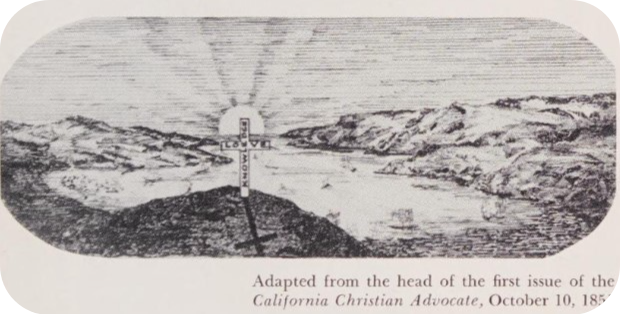
The War for Independence seperated American methodists from the rest of the British societies, and in 1784 the Methodist Episcopal Church (MEC) was fully organized in Baltimore. Since the labors of traveling preachers followed pious settlers, the MEC rapidly expanded from the eastern seaboard across the western frontier.
Methodism's advance to the American Far West was summed by D.D. Forsyth in 1918:
"Following the little groups of pioneers westward across the Alleghenies and the Rocky Mountains, and finally to the coast, the Methodist Episcopal Church has pitched its tent wherever a handful of settlers have made a clearing and built their homes. The great number of these little hamlets which had to be ministered to made the circuit system of the Methodist Episcopal Church one of the important living links between these people" (Christian Democracy, p. 40)
In 1834 a Methodist mission arrived in the Willamette Valley of Oregon under the supervison of Rev. Jason Lee. By 1846 associates of the Oregon Conference came to Alta California: first, in San Jose by dint of J. Aram's wagon train, and then in San Francisco (Yerba Beuna) by W. Roberts' voyage by schooner.
In 1849 the Oregon conference commissioned a California District, supplying formal oversight with the arrival of missionary superintendents, the Revs. Owen, and Taylor. Rev. William Taylor ("California Taylor") is remembered as one of the greatest missionary bishops who traversed the globe, yet his work started with the methodist people in San Francisco, San Jose, Santa Clara, and Monterey.
When this work began, both Alta California and the Oregon Country belonged to the foreign mission field...before they established their own individual, statewide Annual Conferences..., "whose genesis would form a volume of surpassing power and interest" (p. 675, Illustrated History of Methodism). After Methodism's Pacific organization, California further advanced missionary work as a natural gateway to Hawaii, much of Oceania, and the wider Orient. Overseas work was greatly helped by the Methodist Woman's Foreign Missionary Society (WFMS).
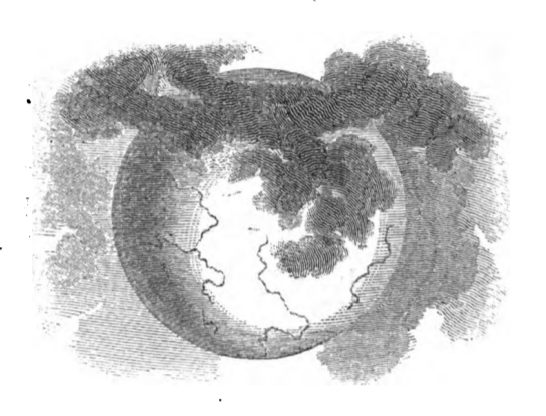
In 1851 the California Conference was officially instituted. The new Conference, in Minervian fashion, quickly became self-sufficient and influential, largely due the enormous distance of California from New York, but also by the gush of Argonauts generated by 1848 Gold Discovery. The ME Church eagerly founded California colleges like University of the Pacific, MacClay College, Pacific Methodist, and even University of Southern California.
Among the numbers of families that arrived with Captain Aram's wagon company, were several Presbyterians from the Cumberland church. These people joined the methodists, making first meetings in Santa Clara and San Jose. Later, during the Great Depression, Presbyterian and Methodist congregations reunited as an ecumenical Federated Church, spanning the Depression era but separating again after WWII.
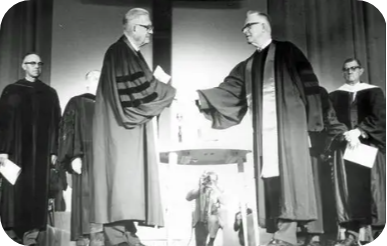
In 1965 our church moved from Santa Clara's old downtown (the Old Quad) to our present location, next to Lincoln St./ Warburton Aves. On April 23, 1968 we became the United Methodist Church. Yet, as a '46er church, we've played a unique role in the history of Santa Clara, California, and Pacific Rim.
-
Location