Third Plaque (Final Draft)
note: this would be the church's third plaque. The first one is alongside our stained glass windows, dedicated 1974. The second one is already on the Bell Wall, dedicated 1980.
"The history of a church is not the story of its buildings, but the story of the people who have prayed, sacrificed, and worked to provide a place in which their children could be instructed in Christian traditions and in which the people might share Christian fellowship”—R. T. Des Jardins
The “Bell Wall” recalls the labors of Methodist people who emigrated from Missouri to California, landing at Mission Santa Clara, October 16th, 1846, as recorded in Margaret Hecox's journal.
Led by Cpt. Aram, the Hecox family and other settlers accomplished many firsts in and around the county. Continuous services began Nov. 2, 1846, with Mr. Adna Hecox's sermon, titled 'How Short our Time is'. These dates confirm the Methodists of Santa Clara as the first Protestant congregation in California.
Our Bell summoned six generations of churchgoers before it was hung here in absence of a suitable tower. It is a symbol that reminds us who we are as people named Methodists, called always to be pioneers in Faith and to promote Christ’s Church in this Valley.
Today, the garden is kept by the original Santa Clara church with their sister congregation, Bethel Korean UMC.
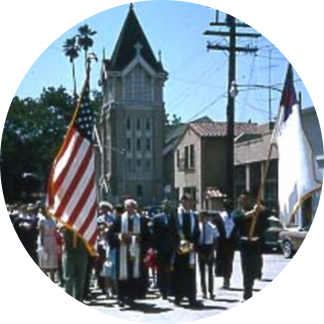
Quotes & Sources
from Rev. C. Sander's SCUMC Webpage titled "Serving Santa Clara since 1846"
"Santa Clara UMC is the oldest Protestant church west of Mississippi River. Our church is open to people from all backgrounds and religious traditions. We welcome everyone... as beloved children of God."
From our 175th Anniversary Bulletien, entitled 'A Short History of Santa Clara United Methodist Church'
"The first Protestant sermon on record in Alta California was preached in William Campbell's adobe home in late 1846; from this, our church traces its history. In March, 1851, with guidance of new preacher Charles Maclay, residents of the new Town of Santa Clara built what we refer to as 'the Adobe church', in the 'Old Quad', partially with material from Mission Santa Clara. Isaac Owen (formerly an illiterate blacksmith), first superintendent of the Methodist Episcopal Church in California, with other organizers obtained a Charter for the California Wesleyan College (later the University of the Pacific) at the first seession of the State Legislature. The deed to the Adobe church property was recorded, and the church incorporated by Rev. Daniel on March 17, 1856, thus the oldest church in Santa Clara County.
In 1975 Pastor C. Haltzman'Frazier gave a brief history for Santa Clara UMC in our church Directory
"Methodism in California had its beginnings in the Santa Clara Valley in 1846. The Wesley traditions were carried here by the early settlers from Missouri. It was here, in Santa Clara, that the Methodists conducted the first Protestant services in California.
The three Campbell brothers William, Thomas, and Charles came to the mission settlement. They were to provide important strength and resources for the growth of Methodism.
William Campbell took up residence in on of the adobe buildings belonging to the mission, about fifty feet from the Catholic Church. It was here that the first Methodist sermon in California was preached by Andy Heacox. Subsequently, Mr. Campbell conducted the service.
During this period Mr. Campbell made the first map of the town of Santa Clara. The map was made for Rev. Father Real, the last of the Franciscans.
By the fall of 1847 the Methodist moved their services to San Jose. They had intermitant leadership until 1849 when Rev. Wm. Taylor, later bishoop and missionary to Africa, held services for twelve in Santa Clara.
In 1850 the Methodists joined with other denominations in Santa Clara to erect a church. It was here that Charles Campbell often preached. However, by 1852 there were enough Methodists to set up a separate congregation."
From SCUMC's '160th Anniversary Invitation'
"Adna A. Heacox preached his first sermon in William Campbell's adobe home in November 1846. It is believed to be the first Protestant sermon of record, preached in what is now the State of California. In 1851 an organization of the Methodist Episcopal Church South was made under the direction of Dr. Jesse Boring, a missionary sent to California by the newly formed Methodist Episcopal Church, South; and in March 1851, Charles Maclay was made the Preacher-in-charge at Santa Clara and under his guidance the Methodists erected the 'Adobe' church, the first, on the site that is currently occupied by Liberty Tower.
Isaac Owen and others applied to the first Session of State Legislature for a Charter for the California Wesleyan College, a name later changed to the University of the Pacific, and a Charter was granted on July 10, 1851. The deed to the (Adobe) church property was recorded; and the church was incorporated by Rev. Daniel on March 17, 1856. This makes it the oldest incorporated church in Santa Clara County."
By James L. Woods in the California Pioneer Decade of 1849 copyright 1922
Woods' history is generous, dealing with Pioneer Churches of all denominations. How we reckon 'the first' of anything often has many qualifiers. SCUMC's reckoning is from Hecox's sermon in November whereupon continuous fellowshp was kept until the Conference sent regular ministers to order their congregations. Woods' is very aware of these qualifiers as he explains their mutual circumstances, p. 21:
"January 1, 1849, there was not an organized Protestant Church in California.
As noted elsewhere, in 'Protestant Beginnings', there had previously been various services such as prayer meetijngs, Sunday school, class meeting, occasional preaching by local preachers and ordained ministers and, for a short time at the close of 1848, stated services in San Francisco by Dwight Hunt. But there had not been any organized churches."
Clifford M. Drury's Chronology of Protestant Beginnings (1946) published by The Centiennial Committee of the Northern California- Western Nevada Council of Churches.
Drury repeats the same line of logic as Woods (above), admitting nuances with regards to the 'first', explaining:
"This committee has held several meetings to evaluete and systemitize the available data. It was found that the conflicting claims of some of the denominations to th edistinction of being 'first' in a particular field could be clarified by remembering that certain churches or denominations prefer to commemorate the beginning of reghular services rather than the date of the formal organization of a church. The committee decided to accept for each denomination its own definition of a church and the corresponding dates of origin."
Drury thusly lists the beginnings of Methodism in late 1846 as well as the fluidity between its people in Santa Clara and San Jose:
"November In the latter part of this month, Protestants at Santa Clara began regular Sunday services, largely under Methodist supervision. Adna A. Hecox, a Methodist local preacher, was the main laeder until he moved to Santa Cruz in February 1847. The Santa Clara group changed the site of its worship to San Jose in the summer of 1847."
From Santa Clara's 100th Anniversary Brochure (1946)
"Methodism in Santa Clara had its beginning in the town of Santa Clara.
About the first Sunday of November 1846, Adney A. Hecox, a local preacher from Michigan, but of late from Galena, Illinois, preached the first sermon in an adobe building belonging to the Catholic mission, a building which stood fifty-five feet west of the present Catholic church. The adobe building, the home of William Campbell was used as the preachinig place of Heacox until the following February when he moved to Santa Cruz.
After Heacox left, Campbell, with the aid of exhorter Jones, continued the preaching throughout the summer months.
In September 1849 Charles Campbell, a brother to William, arrived from Kentucky and organized the first class in San Jose. The Santa Clara work was then transferred to San Jose.
On January 29, 1890, William Taylor, the great Methodist leader, left San Francisco for Santa Cruz. He preached the fellowship Sunday in San Jose and in the evening preached in the Wallace Finley home in Santa Clara. About twelve people were present."
From Earl Printz's The Methodist Church: 160 Years in Santa Clara California published 2006
Printz's history is the most comprehensive and was truly a labor of love for our church. He describes the trek across America's western wilderness, events of the Mexican War, and the irregular nature of the ministry until William Taylor's arrival, pp. 1, 3, 6, 7, 8, 10:
"This chapter could have been called The Mission Church, as indicated by the subtitle, but there was a strong Methodist fellowship in the Santa Clara Valley before the Methodist mission activity got here, and this is an effort to understand and appreciate the vitality of that fellowship.
Methodism in the Santa Clara Valley had its beginnings in November of 1846 in the town of Santa Clara, which was at the time a U.S. Military post under the command of Capt. Thomas Fallon in Mexican Territory. It began as a simple home meeting of newly arrived immigrants from the East before becoming a missionary station of the Methodist Episcopal Church. The history of Santa Clara Station, Methodist Episcopal Church, is closely intertwined with events in the early history of California"
... The story begins in May 1846, the same month the United States declared war on Mexico after a Mexican calvary patrol penetrated north of the Rio Grande and killed an American soldier. In the first week of the month, a number of emigrant wagons arrived at Independence, Missouri, at the same time, and they banded together to form wagon trains for the four to six-month trk to Oregon and California. Among these were the Bryant-Russell, the Young-Harlan, the Boggs-Aram and the Donner-Reed parties, bound for California.
In contrast to the sad fate of the Donner-Reed party, in October of 1846, after traveling the long route through Oregon, a party of 57 people and 15 wagons reached the Sacramento Valley and, after a brief rest (probably near Sutter's Fort), they pressed on to Santa Clara, arriving the first part of November. In this party there were a number of individuals who had important roles in teh establishment of Methodism in Santa Clara Valley. Among them was William Campbell and his family, members of the Methodist Episcopal Church South, Salinas County, Missouri. Adna A. Heacox and his family were also in the group...
During the winter of 1846, the war with Mexico was nearing its climax. Most of the fighting in California was around San Diego. Col. John C. Fremont and his volunteer battalion had marched off for Los Angeles, leaving their families at the Santa Clara Mission. It was on this Mission that Don Francisco Sanchez was descending with a force of about 150 well-armed Spanish Californians, bent on revenge for the pillage of his rancho by the Americans. Barricaded inside the Mission, 175 American men, women, and children prepared for battle under the leadership of Capt. Joseph Aram. The big wooden gates in the wall were jammed shut with trunks of trees and, as night fell, every man who culd handle a weapon was posted at a strategic spot. In the crumbling belfry of the old church, a lookout peered northward into the darkness, while in the adjacent field of mustard 32 armed men huddled in wait for the advancing horsemen of Don Francisco. After a tense and fearful night, the 'Battle of Santa Clara', when it came, was almost an anticlimax. There was much skirmishing...
According to the statement of William Campbell, which was given to Joseph A. Bruner in 1870 (Bruner was at that time Pastor of the church in Santa Clara), Adna A. Heacox (or Hecox) preached his first sermon in Campbell's adobe home, sometime during November 1846. It is said to be the first Protestant sermon of record preached in what is now the State of California....
William Campbell was in that first group of American emigrants to arrive in Santa Clara in October, only a few months after the Bear Flag was raised over Sonoma....
The small group to which he had first preached in Santa Clara continued to meet, with Mr. Hecox preaching, nearly every Sunday in Campbell's home until February, when Hecox went to Santa Cruz and began preaching there. William Campbell then took charge of the meetings. The group later began holding prayer meetings every two weeks. In these Campbell was assisted by an exhorter by the name of Jones, who came from Benicia for the meetings. These meetings continued through the summer of 1847 and became an established part of community life. For a time, probably desring to enlarge their fellowship, the Santa Clara group joined meetings in San Joe, where E. Anthony had started a class in 1847, but it is said in the Santa Clara tradition that the meetings in San Jose were held without anyone in particular being in charge until September 1849."
From a 1974 Booklet, 'Uniting Past and Present', given for the re-dedication of the Stained Glass Memorial windows:
The 1850 church was likely a meeting house used locally by Protestants. The house was built by William Campbell's nephew, David with members of the family. Other histories indicate the so-called Adobe Church was incorporated in 1856.
"Methodism in California had its beginnings in the Santa Clara Valley in 1846. The Wesley traditions were carried here by the early settlers from Missouri. It was here, in Santa Clara, that the Methodists conducted the first Protestant services in California. Three Campbell brothers William, Thomas, and Charles came to the mission settlement. They were to provide important strength and resources for the growth of Methodism. William Campbell took up residence in one of the adobe buildings belonging to the mission, about fifty feet from the Catholic Church. It was here that the first Methodist sermon in California was preached by Andy Heacox. Subsequently, Mr. Campbell conducted the service.
By the fall of 1847 the Methodists moved their services to San Jose. They had intermittant leadership until 1849 when Rev. Wm. Taylor, later bishop and missionary to Africa, held services for twelve in Santa Clara. In 1850 the Methodists joined with other denominations in Santa Clara to erect a church. However, by 1852 there were enough Methodists to set up a separate congregation.
The land for the Methodist Church was situated on part of th esix acre square marked Public Square on William Campbell's map. Part of this square had been used by the mission as a corral. The adobe walls of this corral were used for the construction of the church. This adobe church was completed and became the oldest incorporated Methodist Church in Santa Clara County."
From Richard H. Dillon's California Caravan published 1966, the introduction
In California Caravan Dillon edited Margaret Hecox's journal, writing a fine introduction where he filled some gaps from Mrs. Hecox's diary. Dillon seems to get Adna's Sermon date wrong since the majority of sources mark Nov. 2nd. Nonetheless, Dillon has a nice summary of the Methodists' landing, pp. 16-17
"On October 1, 1846, Joseph Aram and John Kearney rode into Johnson's Ranch on Bear River. The overland trek was finished but the worst was not over, yet. They were welcomed at Fort Sutter by hosptiable adn generous John Syutter ("Should you need any beef, just go and help yourselves to as much as you want, and anyting else that I have is at your service," wer the Swiss's words), but John C. Fremont, camped on the American River urded them to make haste for Mission Santa Clara and to fortify its buildings because of the Mexican War which had just broken out. The party, about fifty-sleven strong now, followed the Pathfinder's advice and hurried their dozen or fifteen wagons to Santa Clara, barricaded the ruinous Mission buildings, and formed up a thirty-five man military company with Joseph Aram its captain.
About 175 Americans were eventually besieged in Mission Santa Clara. The Mexicans did not attack but tried to keep them penned up and hungry. Kndly Ignacio Alviso, however, furnished the Americans with wheat and the mill ground all day long and even when the doors and windows were bolted for the night and all visitors turned away. Typhoid soon broke out in the damp and crowded quarters adn took eight lives by February 8, 1847; before the pioneers left the Mission six more wojld die. Adna Hecox, though wasted and enfeebled by sickness, himself, hobbled to the funerals and, in the case of a daughter of Silas Hitchock, he preached on December 15, 1846, while leaning heavily on his cane, the first Anglo-American sermon in California, titling it "Rember How Short My Time Is." "
Perhaps our most important primary source-- Margaret Hecox's Journal which has more prescience than Aram's latter recollections to the Mercury News. Margaret give us the Oct 16th date for the landing but no date for her husband's sermon in November, pp. 43-46
"It was on the first day of October, 1846, that our eyese rested upon the Sacramento Valley. It was four o'clock in the afternoon when our train halted on an elevation, while our wondering eyes looked down upon the new land, our future home. We were silent a moment in thanksgiving. Then from the throats of those weary emigrants burst forth a loud and long 'hooray' which echoed through the hills. We dropped on our knees and gave thanks to God, who had watched over us adn brought us safely through the perils and privations of the long journey...
In a day or so orders came from Fremont that the women and children must be hurried to the Mission of Santa Clara for protection as quickly as possible. Our few remaining men were advised to take charge of the Mission buildings, and form themselves into companies for the protection fo their families. More emigrants were on the way, and soon would reach California, it was learned, so that reinforcements to our ptiiably small number of men able to fight would soon be at hand...
How well I remember our first sight of San Jose. Such a quaint little city it was; just a handful of adobe buildings, and nothing more. A few Americans lived here we were informed. A Mrs. Captain Hanks presented each family with a loaf of bread. We did not linger at the Pueblo, but hurried on to Santa Clara, where we were to find shelter inside the Mission buildings until the trouble was settled. On the eve of the 16th of October, 1846, we arrived safely at the Mission of Santa Clara."
From Leon Loofbourow's Cross in the Sun (1966) and In Search of God’s Gold (1950)
These quotations were taken from Leon Loofbourow’s mid-1950’s writings, also adopted by our California-Nevada Conference. From Cross in the Sun, p. 12:
“In 1845 the first Methodist family of record reached California. In 1846 fourteen more families came, including a licensed Exhorter. In 1847, among the immigrants, was a Local Preacher. That year a ‘Class’ and a Sunday School were enrolled—the beginning of organized Protestant work in California. And in 1849 came two ordained Methodist missionaries.”
Of course, the fourteen families which crossed the Sierra were Aram's wagon train with exhorter A. Hecox. The 1847 preacher was ex-Quaker, Elihu Anthony. And, the forty-niners were likely Oregon-mission appointees, Revs. Taylor & Owen. Among our local methodist superintendents, Owen and Taylor are foremost.
Loofbourrow makes an important distinction with the beginnings of Santa Clara's work in the terms 'congregation' rather than 'class' or 'church'. From In Search of God's Gold, p.31:
"Which comes first in the church, laymen or preachers? Well, in California at least the laymen beat the preachers to it.
On October 1, 1846, the first Methodist family of record reached Sutter's Fort, and moved on to Santa Clara. Adna A. Hecox was a licensed exhorter. Colonel Sanchez led a movement among the Mexican against the incoming emigrants. While the latter were huddled in an adobe building for protection typhoid fever broke out, claiming eight lives. Hecox, 'feeble in body, leaning on a staff', preached a funeral sermon from the words, 'Remember how short my time is'. Of this th echroicler says: 'This was, without doubt, the first Protestant sermon ever preached within the present limits of the State of California.
But religion did more than bury the dead. A congregation was gathered. On November 3 to 10, 1946, the Community Methodist Church of Santa Clara observed its centennial. For the little group in William Campbell's house which listened to Hecox has lived through its many vicissitudes. It offers good evidence that it is the first continuing Protestant congregation (not a formally organized class or church) in the state."
From J Winkley's Sourvenir Bookle, 'The Methodist Pioneers of California', printed 1947 with a preface by Loofbourow
Winkley dates our landing by wagon train Nov. 1846 which has been carried forward by some historians. However, our church plaque says October. Nonetheless, Winkley admits:
"At least one Methodist family antedated the year 1847 in California, for Adna A Hecox, from Michigan, arrived at Sutter's Fort on October 1, 1846. The family rested there for a few weeks, then went on to the Santa Clara Valley which they reaced on November 1st. It was during this Fall that Col. Fremont had enlisted all able-bodied American setttlers for his campaign into Southern California. A Col. Sanchez of the enemy took this opportunity to arouse the Spanish against the Americans of whom about 175 were then living in the Santa Clara valley. For mutual protection these settlers gathered in an old, barn-like barracks in the vilage of Santa Clara where they suffered from disease, cold, and hunger until rescued by the Marines from the U.S. Fleet in San Francisco lharbor under Capt. Marston. Col. Sanchez was defeated in a desultory skirmish and compelled to surrender.
While the American settlers camped in the cold, damp barracks, an epidemic of typhoid fever raged among them and many died. Adna Hecox, as a local preacher of the Methodist Church, though in feeble health himself, conducted the funeral services. At the funeral of the daughter of Silas Hitchcock, he preached a sermon on the text, "Rember how short my time is". This was probably the first Protestant sermon given in the State of California. Hecox held Sunday Services there until he moved to Santa Cruz in February 15, 1847, and in his new location continued to preach whenever the opportunity afforded."
C.V. Anthony Fifty Years of Methodism. published 1901
p. 7-8
"The year 1846 marked a period of unusual immigration into the territory of California. It will be remembered that the Donner Party were caught in a snow storm that year, and had to spend a winter of indescribable hardships near the lake that bearts their name. Only a remnant reached Sutter's Fort in the early spring. Another party of fifty-seven souls, with fifteen wagons, reached the Sacramento Valley on the first day of October. After a brief rest, they pressed on to Santa Clara, which place they reached about the first of November. Among these were Adna A. Hecox and family. He and wife were members of the Methodist Episcopal Church, and he had a license to exhort. About this time the settlers were exposed to a danger even greater than any to which they had been subjected wile crossing the plains. Col. Fremont left for the southern part of the territory, and taking advantage of his absence, Col. Sanches induced the natives to rise against the 'Americanos'. There were one hundred and seventy-five of these at that time in Santa Clara who were closely beseiged by the Mexicans. To make their condition more wretched, typhoid fever broke out among them in a very maignant form. Eight deaths occured before the first of February. Mr. Hecox, 'feeble in body leaning on a staff', attended the funderal services of these as they transpired. At the obsequies of a daughter of Silas Hitchcock he preached a sermon from the words, 'Remember how short my time is'. This was, without doubt, the first Protestant sermon ever preached within the present limits of the State of California.
No sooner had these immigrants reached the country than agents of the United States solicited all the young men, and such others as could leave their families, to enlist in the war. Some of these under command of Capt. Weber, united with the marines under Capt. Marsden, fought against Col. Sanchez and his forces near Santa Clara on the first day of January 1847. A desultory conflict was kept up until the eighth day of the month, which Col. Sanchez surrendered. This closed the war in Northern California.
From the first of January until the middle of February, Hecox, having recovered his health sufficiently, held meetings sabbath eveings. In these he earnestly exhorted the people to attend to the salvation of their souls. He then moved to Santa Cruz..."
Below are extracts from Horace Foot's Pen Pictures from the Garden of the World, or Santa Clara County (1888).
About the town of Santa Clara, Foote says, p. 205
"The early history of San Jose and Santa Clara run in parallel lines. The connection between the two places has been so intimate, and they are so closely joined by location, that they will before many years become on city."
Under the heading of 'sketch of methodism', speakinig of the work of the methodists and succession of ME appointments, Foote concludes, p 207-8
"From this sketch it wouold appear that Santa Clara is the oldest university town in the State [he is likely speaking of both Santa Clara U and Pacific U.], and the Santa Clara Church is the pioneer, the mother, grandmother, and great-grandmother of al the churches. Yet her eye is not dimmed nor her natural force abated."
The following is First San Jose's Centenary, 1847-1947.
First UMC no longer exists, but their early history is so interwined with Santa Clara, William Campbell, and Cpt. Aram's wagon train that First was virtually interchangable with SCUMC. The centenary's editor, Howard A. Christman, notes this:
"A survey of the available evidence supports the historic fact that we must look to Santa Clara-San Jose for the beginnings of Protestantism and the Methodist church in California. For other communities to claim the priority is to definitely distort the historic picture. From the beginnings of the group that assembled in Santa Clara in the fall of 1846, under Methodist leadership, it is the record of a group with an existence and a leade rship. The very definite evidence from the memoirs of William Campbell, given just a little more than a score of years after the events in which he shared, assuredly cannot be disregarded. After those few weeks in Santa Clara the identity of th e'class' is to be associated with both Santa Clara and San Jose, alternating between those two communities so close together, but through the tie that binds in Christian devotion the small fellowship would feel the more near to each other. This then is the historic situation that preceded the more definite organization of a 'class' in October 1847, under the Rev. Elihu Anthony. The beginnings of Protestantism and of the Methodism in California are to be placed in this locale."
The Earl Printz summarizes the significance of Aram's landing in two places in 160 Years,.
In the Preface, p. vii, Printz says:
"The writing of this history was undertaken in connection with the celebration of the 160th anniversary of the first Methodist assembly in Santa Clara Valley. So far as we know, it was the first Protestant meeting of record in California.
Obviously the present church building has no long history, but the present congregation has a more or less tenous connection to those brave souls who crossed the plains and mountains in 1846 to begin new lives and establish the values of Methodism in their new place, Santa Clara Valley. This is not the story of a church building; it is, rather, the account of continous Methodist fellowship, and the people in it, which has presisted in the same location through difficult times, economic hardships, civil war, world wars, depressions and religious controversies. It is that continous fellowship over time in the same place which connects the present Santa Clara United Methodist Church with the beginning in 1846. It is a tale of hardship, tragedy, perseverance, courage and hard work by men and women of faith and miracles of Divine Providence."
Printz uses studied words when he describes the precedent set by the wagon train on pp. 16-17,
"The group which gathered in William Campbell's home in November of 1846 to hear Heacox preach continued to meet through many vicissitudes and became the "first continuing Protestant congregation (not a formally organized class or church) in the state." Leon Loufborrough writes in his In Search of God's Gold that the earliest Protestant religious service conducted in California as an American possession, of which there is a record, were the services held by the emigrants who were quartered in the ission buildings in Santa Clara during the winter 1846-1847. In these services Protestantism was planted in California on a continuing and permanent basis."
-
Location